Installed Speaker Upgrade

STTNG has excellent music and great speech sounds recorded by the original cast, but through the stock speakers… well, let’s just say it could sound better 🙂 There are a couple manufacturers of speaker upgrade kits for pinballs – Pinball Pro and Flipper Fidelity seemed to be the most popular two.

I decided on the Flipper Fidelity Premium DCS Speaker Kit for upgrading the STTNG machine. It comes with replacement speakers for both backbox speakers and an 8″ woofer for the cabinet. Some nice things are included in the kit.

  • Spacers are included for the speakers such that they can just be screwed in without any modifications needed to the cabinet.
  • A volume/level control is included to control the balance between the cabinet woofer and backbox speakers

Received the kit quickly and in great condition, and was excited to install it. Easy as pie and pretty much exactly as described in the instructions.
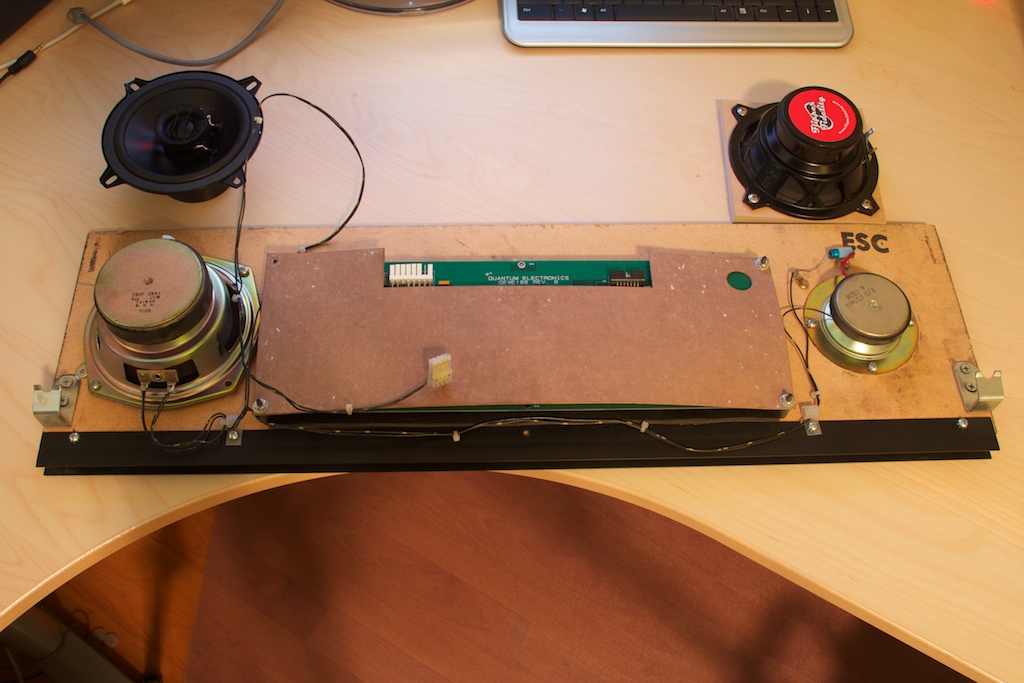
Here I have removed the backbox display and speaker panel. You can see the stock speakers still on the panel, and the new Flipper Fidelity replacements above. Notice how the stock right speaker is tiny compared to the left one!

Given the included adapter bracket in the kit, installing the right speaker is a piece of cake. I did have to slightly enlarge the holes in the bracket using my drill, but that was a 30 second fix.

The included level control is pre-wired and ready to plug-and-play. I installed it in the top right of the backbox as suggested in the instructions. Three sets of wires come out of it, and it is a simple matter to complete the connections:

  • Molex connector to the audio board
  • Left speaker
  • Right speaker


Here is the stock woofer at the bottom of the cabinet. Removed four 5/16″ nuts that held it in place…

… and replaced it with the Flipper Fidelity adapter bracket. Since the new speaker is bigger than the old one, the bracket allows the new speaker to be installed without drilling any new holes into the cabinet! Brilliant!

And finally here is the new woofer wired up. The crossover PCB has two positive (+) terminals, a high and a low, that can also be used to select the level of bass desired. After trying the high output and finding it a bit much, I used the low output, which is just perfect.

So how does it sound? Definitely a huge upgrade over the stock speakers. It’s a double-win: The bass is much clearer and deeper, and the mids and highs are also much clearer and pleasant sounding. As for the kit, I really like that the included level control allows you to control the balance between the backbox speakers and the woofer – it’s almost like having a “bass” knob like you have on your sound system. The installation was easy and quick, and given that no wire cutting was required and through the use of the supplied adapter brackets, the speakers could be just as easily returned to 100% stock configuration if you ever so desire! I definitely recommend Flipper Fidelity to whoever is considering a speaker upgrade for their pin.

Posted in Uncategorized | Leave a comment

Opto insanity!

After replacing the power driver board, I thought all was well, but unfortunately it wasn’t so. 😐 The machine would play normally most of the time, but then all of a sudden in the middle of a game it would go completely hay-wire and start triggering every functionality in the game simultaneously. Needless to say, the game would get extremely confused and eventually simply reboot.

At first I was worried I was still having power issues. And with a brand new power driver board! Very frustrating, especially since the problem was so intermittent. In the end the switch test mode proved invaluable in debugging the issue. As soon as the machine started acting up, I went into switch test mode, which revealed that all the opto switches were flipping between on and off at an extremely high rate of speed. After a few seconds, they would stop, at which point the game would play normally again.

An opto switch is a combination of an infra-red transmitter and receiver. The transmitter part is always on, and when some object (the ball, a drop target, etc) blocks the path of the light to the receiver, the machine can sense it. Since pretty much all the optos were firing at the same time, the problem seemed to be with something common to every opto that was mis-behaving. This lead me to suspecting the power connection that feeds all the opto transmitters. Looked it up in the STTNG manual, and found that the optos have a common power lead at J117 on the power driver board.

Sure enough, this connector looked really flaky! And better yet, if I fiddled with the connector with the machine in switch test mode, I could reproduce the opto insanity! It was pretty clear that this flaky connector was the source of the problems. There’s so much vibration in pinball machines that a flaky connector will work one second and not the next.

Some googling revealed these are .156-series molex connectors. A trip to my local Fry’s is all it took to get a replacement.

Here at J117 (bottom left of the power board) is my brand new connector. My wiring is spliced in to the original wires. The only reason I didn’t crimp the original wires directly into the new connector is that the original cables were quite short, and I didn’t want to risk running out of cable if I screwed up the crimp and had to start over. Hey, I’m new at this! That said, I can happily report that since my new connector went in, opto insanity is history!

Posted in Uncategorized | Tagged , , | Leave a comment

Replaced Power Driver Board

My STTNG machine was unfortunately suffering from intermittent reboot issues when I purchased it. I knew about the issue when I bought it, but I got the machine at such a great price that it was worth the risk. I figured it wasn’t anything I couldn’t fix 🙂

Adding to the “fun”, there was a standard computer power supply inside the cabinet in addition to the stock transformer! The PC Power supply was wired to the connector that evidently was intended for J114 on the Power Driver Board.

It was a pretty good guess that the reboot issues lied somewhere in the power driver board. Someone before me had obviously taken a short-cut when trying to fix the rebooting problem. Well, I decided the best course of action was to either refurbish the existing power driver board, or replace it altogether with a new board. Since I don’t really have that much experience desoldering and soldering, and the power driver board is really not the best part to practice on, I decided to get a new board. I went with the Rottendog Amusements WDB089.

Installation was straightforward… First, I removed the translite to get into the backbox.

Then, I simply disconnected every connector from the old power driver board.

You can see I labeled every connector so that I would know exactly where to plug them back in. This ended up being unnecessary, since the connectors will only fit on the board in the correct spot. It was then a simple matter of loosening 6 screws and the board came right out.

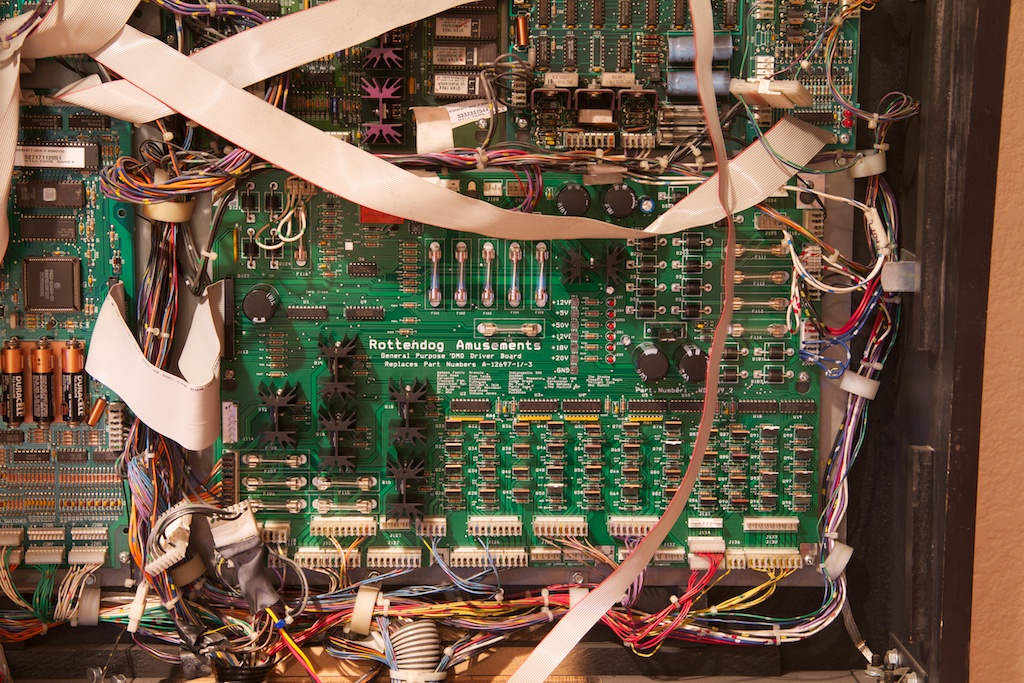
Finally here is the new Rottendog board installed. You can also see in this picture that J114 on the lower left is still not connected to anything, and the PC power supply is still wired up. I removed the PC power supply and re-connected J114 properly.

And now the great news – Rebooting issues gone! Another unexpected surprise is that ALL the solenoids on the machine are now way stronger, including the flippers! 😀 It was immediately noticeable and made the machine even more fun to play. Replacing the board turned out to be not a cheap, but definitely well worth it!

Posted in Uncategorized | Tagged | Leave a comment

Fixed gun trigger

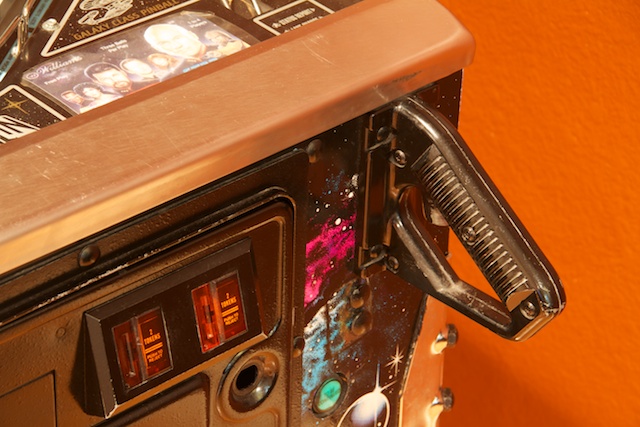
STTNG, like Terminator 2 (another Steve Ritchie machine), has a gun trigger to launch the ball instead of a traditional plunger. On my machine, the trigger was very loose and only had “spring” in the last little bit of the trigger pull. Definitely felt broken.

I looked up the part number for the spring in the service manual, and went ahead and ordered one from Bay Area Amusements. While I was at it, I ordered a replacement wiring harness for the left shooter, because it’s sometimes acting funny – more on that in a future post.

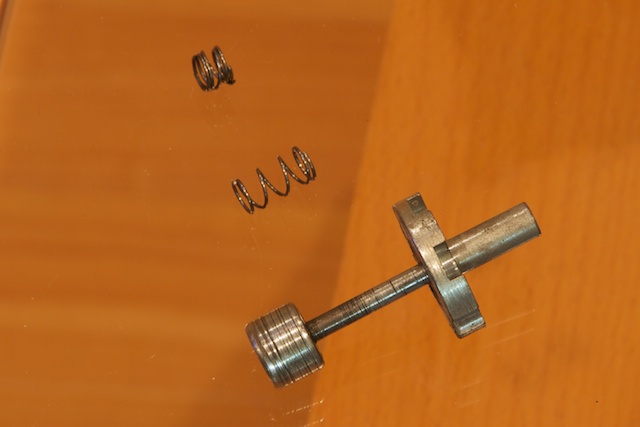
So I went ahead and removed the gun trigger from the machine to see what was up inside it. Four bolts attach the gun handle assembly to the cabinet, and can be easily accessed from inside the cabinet with the playfield raised. As suspected, the trigger spring was beyond toast. Replaced the old collapsed one (top) with the new one (middle), and cleaned the shaft that holds the spring with WD-40 (bottom). Now my trigger works and feels like new! Easy as pie.

Posted in Uncategorized | Tagged | Leave a comment